Visiting Dynjandi Waterfall in Winter
I've watched Dynjandisheiði close for the season more autumns than I can count, and it never happens on the same date twice. Road 60 to Dynjandi waterfall in winter is a real question with a real answer that changes year to year: the heath usually shuts around late October and reopens around late April, and nobody, including the road crews, can promise you an exact week in July for a trip you're booking for December. What I can tell you is how the closure actually works, what the falls look like when they drop to a trickle edged in ice, and which of the Dynjandi waterfall tours that still run in winter get you there when a rental car can't.
Quick answer
You can visit Dynjandi in winter, but not by driving yourself: Road 60 over Dynjandisheiði usually closes around late October and reopens around late April, with the exact dates set by that year's snowfall rather than a calendar. Between those dates, a modified superjeep with a guide is the realistic way in, not a rental car, and the falls themselves run at a fraction of their summer flow.
Key takeaways
- The road to Dynjandi is usually closed from around late October to around late April, dates vary with snowfall
- A modified superjeep with a guide is the realistic winter route in, a standard rental car is not
- Winter flow drops to about 1 cubic metre per second, against up to 8 in summer, and ice builds on the lower falls
- Never treat a winter visit as guaranteed: check the road status close to your date, not months out
- When the road is shut, Ísafjörður itself and nearby Bolungarvík make a real day without it
- Ísafjörður's own mountains block direct sun to the town from late November until 25 January, a stretch locals mark with a festival on Sólardagur
Can You Actually Get There in Winter?
The honest answer is: usually not by car
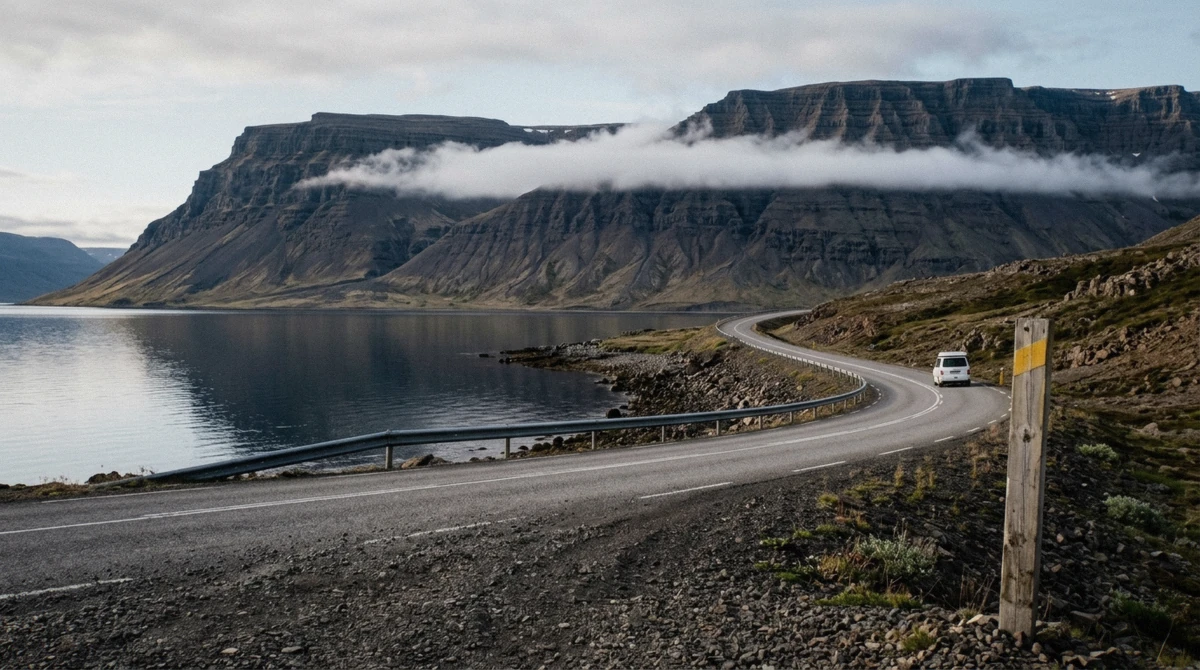
Road 60 crosses Dynjandisheiði on its way to the falls, and that stretch of heath is the part that closes, usually from around late October to around late April. If the heath is closed, a rental car simply cannot make the crossing. It isn't a question of driving carefully.
The road is gone under snow, not merely icy. For the tunnel, the drive time from Ísafjörður and what the car park itself offers once the road is open, see how to get to Dynjandi waterfall.
The realistic way in
A modified superjeep with a guide who knows the route is the way people actually reach Dynjandi outside the open season. These vehicles run oversized tyres at low pressure and a driver who has crossed that heath in far worse conditions than a first-time visitor would ever choose to. The private superjeep tour, priced at $801 per group of up to four, is built for exactly this and works in snow when Road 60 itself does not. Last verified: July 2026.
Book with room to move
A winter departure needs a plan B built in from the start, since the same storm that closes the heath can also ground a jeep for a day. If you're building a trip around a specific date, leave at least one spare day either side of it before you fly home, and treat the booking itself as weather-dependent rather than fixed. A guide who runs this route through the winter will tell you plainly, sometimes the morning of, that today isn't the day, and a good one would rather reschedule you than take a group up in conditions that don't warrant it.
What You'll Actually See
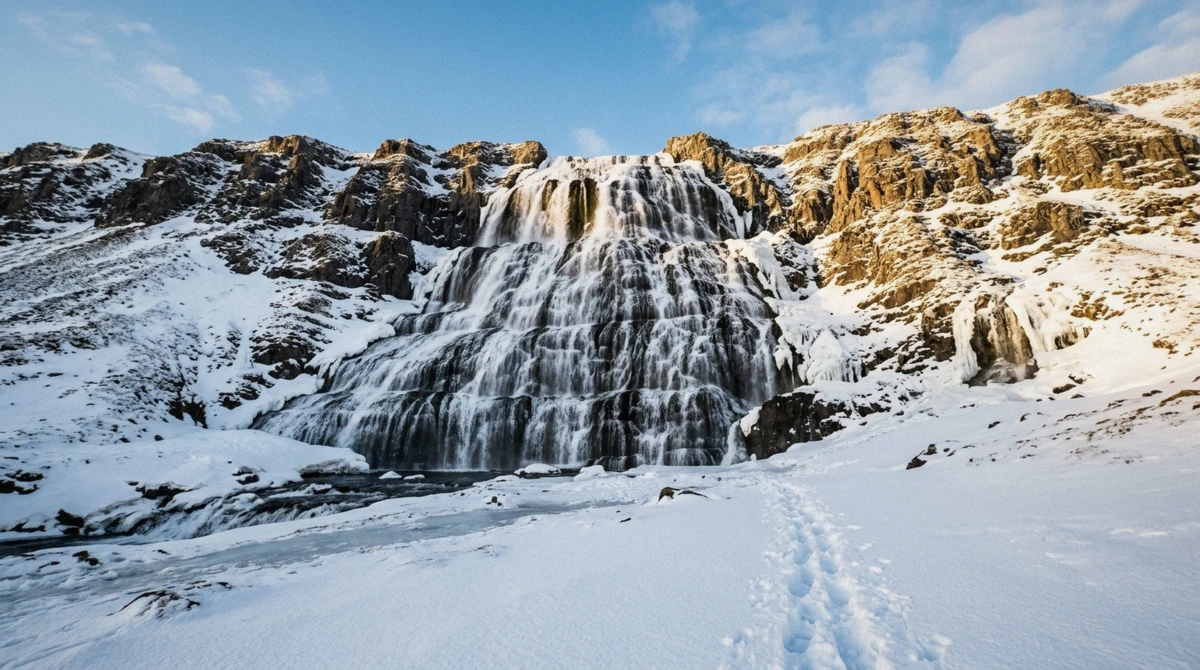
Winter flow at Dynjandi drops to about 1 cubic metre per second, against as much as 8 in summer. The falls don't stop, but they thin: less a wide curtain of white water and more a narrower, harder-edged run down the same stepped rock. Ice builds along the lower falls, sometimes thick enough to change their shape entirely, columns and shelves where summer shows only spray.
It's a different waterfall in every sense but the name, and worth seeing precisely because most visitors never do.
Low winter light changes the falls as much as the ice does. The sun barely clears the ridgeline even on a clear day, and what light does reach the water comes in low and gold rather than the flat overcast glare that's typical of a July afternoon. Snow banked along the path and on the slope above throws that light back at the rock, which is the reason the handful of photographers who make the trip in winter tend to come back with the most striking shots of the whole year, not the summer ones.
Set against that, the walk itself asks more of you: ice on the lower path, shorter daylight to work with, and a guide who knows exactly where the footing is trustworthy and where it isn't.
Winter and Summer at Dynjandi, Side by Side
People ask me whether the winter version is worth the trouble, and the honest answer is that it is a different waterfall rather than a worse one. Here is what actually changes between a February visit and a July one.
| Winter, November to April | Summer, June to August | |
|---|---|---|
| Water volume | Around 1 cubic metre per second, thin and picked out in strands | Up to 8 cubic metres per second, the full fan across the rock |
| The rock | Ice sheets on the lower falls, snow banked along the path | Bare black basalt, green moss on every ledge |
| Road 60 over the heath | Usually shut from late October, reopening around late April | Open, and the drive from Ísafjörður takes under an hour |
| Getting there | A guided superjeep, on a day the weather allows it | Any rental car, or any of the half-day trips from town |
| Daylight to work with | Four hours in December, and no direct sun on Ísafjörður until 25 January | Effectively all day, with the sun barely setting in late June |
| Other people there | Often nobody at all | Full car park whenever two ships are in port |
The trade is straightforward. Winter costs you volume, daylight and certainty, and pays you back in ice, silence and a car park with nothing in it. I have stood there in February with one other vehicle for company and heard the fall from three hundred metres away, which never happens in July.
The Winter Months, One by One
Dates below are the usual pattern, not a promise. Snowfall decides the actual closing and opening each year, sometimes by weeks.
| Month | Road status | What you'd see | Realistic way in |
|---|---|---|---|
| November | Usually closed, often from late October | Early winter flow, first ice forming on the lower falls | Superjeep with a guide only |
| December | Closed | Reduced flow, more ice, short daylight hours | Superjeep with a guide only |
| January | Closed | Coldest month, heaviest ice on the lower falls | Superjeep with a guide only |
| February | Closed | Still frozen at the edges, daylight lengthening | Superjeep with a guide only |
| March | Usually still closed | Flow beginning to shift as snowmelt starts higher up | Superjeep with a guide only |
| April | Variable, often reopens late in the month | Rising flow, ice breaking up on the lower falls | Check road.is before assuming a rental car works |
Some years the heath has opened as early as late March, and at least one recent year it stayed shut into May after a five-month closure. Treat every row above as the pattern, not the schedule for your specific trip.
Planning Around the Season You're Actually Traveling In
If you're arriving in November or December
book a guided superjeep trip in advance rather than hoping the road is still open. It almost certainly won't be by the time you land.
If you're arriving in January or February
plan your Dynjandi day around a superjeep departure and build a backup day into your itinerary in case weather grounds even that.
If you're arriving in late March or early April
check road.is a few days out rather than months out. This is the window where the road could genuinely go either way.
If you're arriving in late April or May and hoping to self-drive
confirm the reopening date close to your trip. Some years it's open by late April, other years it has stayed shut into May.
What to Do Instead When the Road Is Shut
A closed road doesn't mean a wasted day in Ísafjörður. The town itself rewards slow exploring, and Bolungarvík, a short drive rather than a heath crossing, adds a working fishing harbour and its own turf-roofed history without needing Road 60 at all. The Bolungarvík shore excursion runs from Ísafjörður in summer, but the town and the Bolafjall skywalk above it are worth the trip on their own footing, winter included, road conditions allowing on that shorter stretch. Bolafjall's viewing platform sits high above the fjord mouth, the kind of view that doesn't need Dynjandi to justify the drive.
Ísafjörður cruise pier sits a five-minute walk from the town centre, so if you're arriving by ship on a day the heath is closed, you're not stranded. You're in a small, walkable town with cafes, a harbour, and enough to fill a morning without ever needing the road south.
The Dark Months, and Why Locals Mark One Day
Ísafjörður sits far enough north, and close enough under its own mountains, that the sun disappears from the town entirely from late November until the 25th of January. Not shorter days, gone: the peaks around the fjord block the low winter sun from ever reaching the streets. Locals call the day it returns Sólardagur, and it's marked here the way other places mark a first snow or a first thaw.
If your trip lands anywhere in that stretch, the town itself is living through its own seasonal event, which is worth knowing even if Dynjandi is out of reach that week.
Winter Visit Questions
When does the road to Dynjandi usually close for winter?
Road 60 over Dynjandisheiði usually shuts around late October, though the exact date depends entirely on that year's snowfall and can move by weeks in either direction. Check road.is close to your travel dates rather than relying on a fixed calendar.
What happens if the road to Dynjandi is closed when you're there?
A standard rental car cannot make the crossing once the heath is under snow, no matter how carefully you drive. A modified superjeep with a guide is the realistic way in during the closed months, and it's worth booking ahead rather than arriving and hoping.
How much does the waterfall change between summer and winter?
Flow drops from as much as 8 cubic metres per second in summer to about 1 in winter, and ice builds along the lower falls, sometimes reshaping them completely. It runs all year, just as a noticeably smaller, harder version of itself.
Is a winter trip to the Westfjords worth it if Dynjandi itself might be out of reach?
Ísafjörður alone carries a real winter trip: a walkable town, a working harbour, the Bolafjall skywalk nearby, and its own dark-season story around Sólardagur. Icelandic winter travel generally rewards low expectations and flexible plans more than a fixed checklist, and this corner of the country is no exception.
Why doesn't the road just get cleared like a city street?
Dynjandisheiði is a remote mountain crossing with heavy, repeated snowfall and limited traffic to justify constant clearing through the darkest months. Crews reopen it once the snowpack and the forecast make that realistic, which is why the date moves year to year rather than following a fixed schedule.
How close can you get to Dynjandi if the road is closed?
Not close at all. The falls sit at the head of Arnarfjörður, reached only by the road that crosses the heath, so a closure genuinely puts the site out of reach without a guided winter vehicle. There's no roadside viewpoint on the Ísafjörður side that substitutes for the drive.
Winter doesn't rule out Dynjandi. It just changes who gets you there and what you'll find when you arrive: a thinner, ice-edged waterfall reached by superjeep instead of sedan, on a schedule the snow sets, not the calendar.